

- 01000502545
-
This email address is being protected from spambots. You need JavaScript enabled to view it.
QNAP NAS TS-855eU-8G


TS-855eU-8G
An 8-bay, 2U short-depth rackmount NAS designed for compact IT deployments—built for fast backup, shared storage, and virtualization with dual 2.5GbE, M.2 NVMe acceleration, and PCIe expandability.QNAP Rackmount NAS • 2U Short-Depth • Model: TS-855eU-8G
8-Core Intel® Atom® Performance
Intel Atom C5125 (8 cores, 2.8GHz) delivers strong multitasking for business workloads.
2U Short-Depth Design
Optimized for compact racks, wall-mount AV cabinets, and tight network rooms (depth ~11.7").
Fast Networking + Expandability
Dual 2.5GbE built-in, plus PCIe Gen 3 slots for 10/25GbE or Fibre Channel.
Product Images
Use these images as-is, or download + host locally.
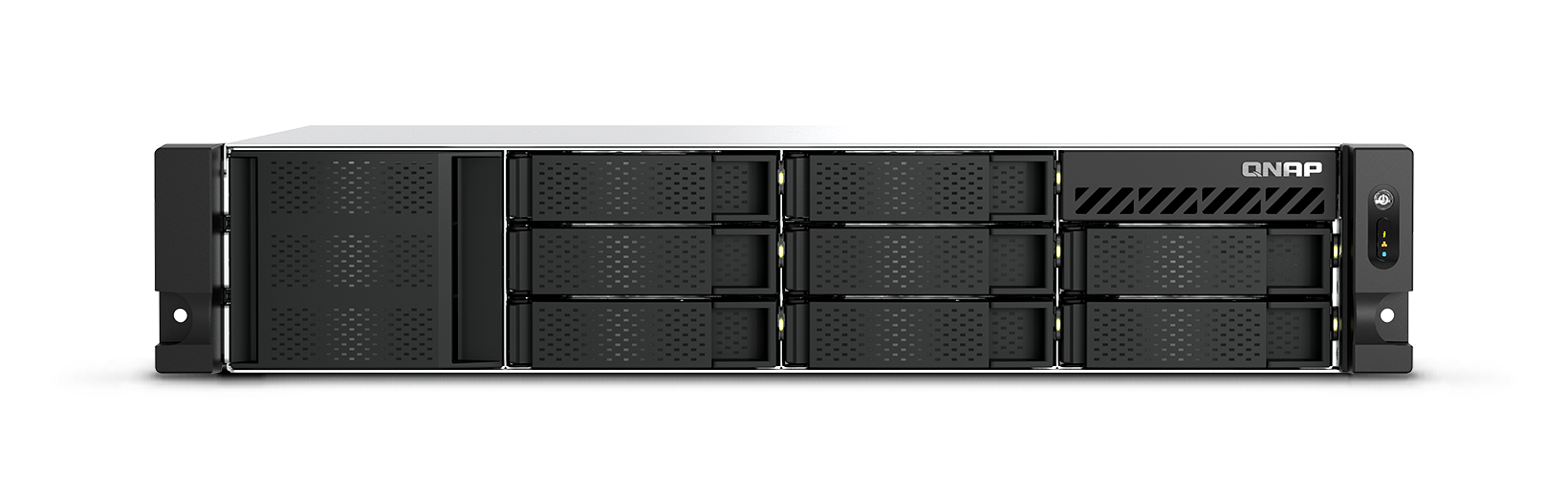
Front View
8-bay 2U rackmount chassis.

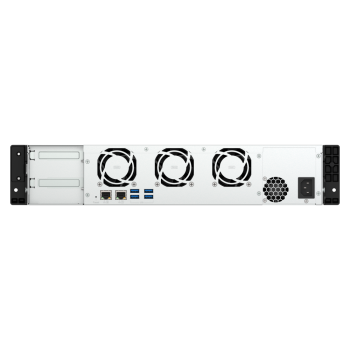
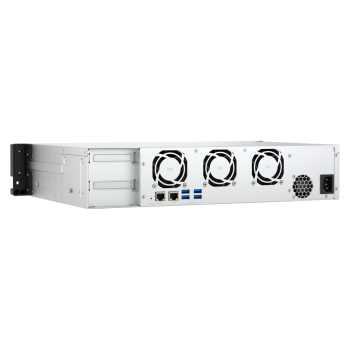
Rear View
Ports & cooling layout (may require local hosting depending on your site rules).
Overview
Built for shared storage, backup, and virtualization in tight rack spaces.
The QNAP TS-855eU-8G is a 2U short-depth rackmount NAS that fits where standard servers don’t—small racks, wall-mount cabinets, AV rooms, and space-limited IT closets. Powered by an 8-core Intel Atom C5125 and scalable memory, it delivers the compute and I/O flexibility needed for modern business storage: fast file access, reliable backup and recovery, snapshot-based protection, and virtualization-ready shared storage.
Why it’s a great fit
- Compact depth for flexible deployment in small racks.
- Dual 2.5GbE for faster file sharing using existing Cat5e cabling.
- Dual M.2 NVMe slots for SSD caching or SSD system pool.
- Dual PCIe slots to scale networking or add SAN connectivity.
Ideal for
- SMB file server & centralized storage
- Backup target + disaster recovery
- Virtualization storage (VMware / Hyper-V use cases)
- Surveillance recording storage
- Branch offices & remote sites
Networking & Speed
Upgrade to 2.5GbE without changing your cabling.

With two built-in 2.5GbE RJ45 ports, the TS-855eU-8G enables smooth collaboration and faster transfers for teams. Need more bandwidth? Add 10/25GbE NICs via PCIe to support demanding workloads such as virtualization, large media projects, or multi-user backup.
SSD Acceleration & PCIe Expandability
M.2 NVMe cache + upgradeable I/O when you grow.
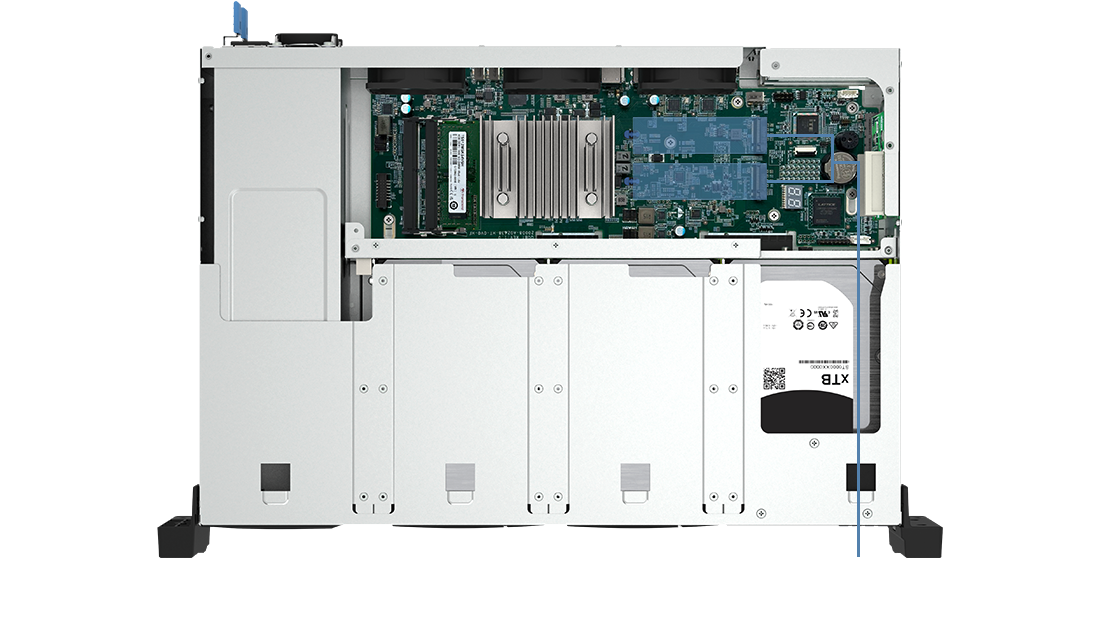
Dual M.2 NVMe (PCIe Gen 3)
Install M.2 2280 NVMe SSDs for caching and improved IOPS, or build an SSD pool for system / metadata acceleration.
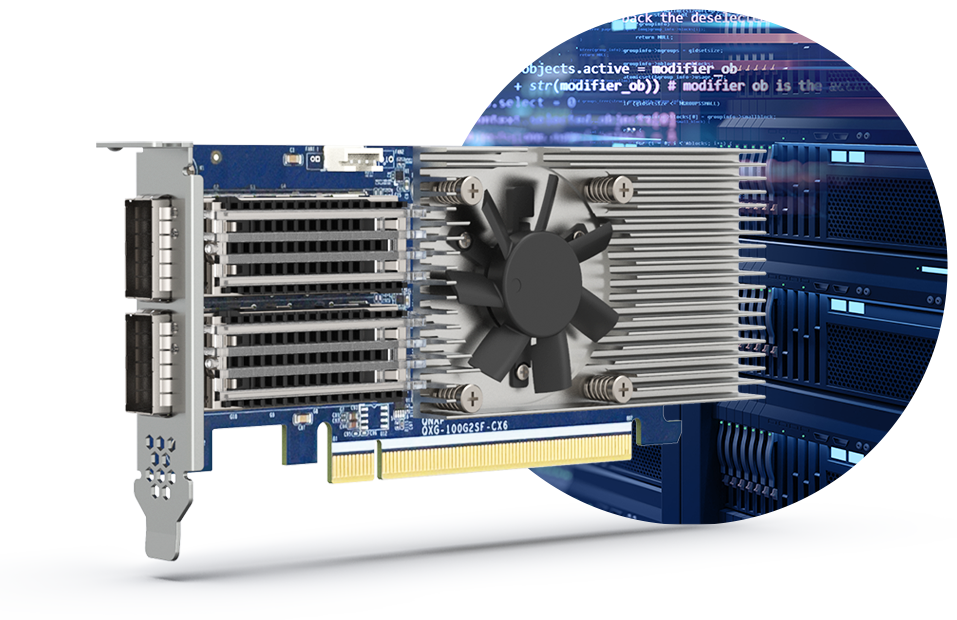
PCIe Expansion
Add 5/10/25GbE networking or Fibre Channel cards to match your infrastructure and performance needs.
Common Deployments
Where TS-855eU-8G shines.
Virtualization Storage
Centralize VM storage with reliable shared volumes, snapshots, and upgrade paths (10/25GbE or FC via PCIe).
Backup & Disaster Recovery
Use as a primary backup target with snapshot protection and fast restore paths for critical workloads.
SMB File Server
Consolidate team files with permissions, fast search, and streamlined access across Windows/macOS/Linux clients.
Surveillance Recording
Build cost-effective recording storage with the capacity to scale and the footprint to fit compact environments.
| Operating System |
QuTS hero h5.2.5 |
| Supported Client Operating Systems |
|
| Supported Browsers |
|
| Supported Languages |
Chinese (Traditional & Simplified), Czech, Danish, Dutch, English, Finnish, French, German, Greek, Hungarian, Italian, Japanese, Korean, Norwegian, Polish, Portuguese (Brazil), Romanian, Russian, Spanish, Swedish, Thai, and Turkish |
| Storage Pool |
✓ |
| SED Storage Pool |
✓ |
| Maximum Pool size |
5 PB |
| Maximum number of storage pool |
128 |
| Shared Folder Type |
Thick, Thin |
| Maximum shared folder size |
5 PB |
| Maximum number of shared folder |
256 |
| JBOD Expansion |
✓ |
| VJBOD / VJBOD Cloud |
✓ |
| iSCSI Service |
✓ |
| Fibre Channel Service |
✓ |
| LUN Type |
Thick, Thin |
| Block-based iSCSI LUN |
✓ |
| Maximum LUN size |
1024 TB |
| Maximum number of targets LUN |
256 |
| RAID Type |
|
| RAID Group |
✓ To ensure data security, system stability, and storage performance, the maximum number of drives for a single RAID group is now 16 (applicable to RAID 5, RAID 6, RAID TP, and subgroups of RAID 50 and RAID 60). Nevertheless, users can combine multiple RAID groups into a large storage pool that contains more than 16 drives, using RAID 50, RAID 60, or RAID 10 as the RAID configuration. This enhancement will only be applied to new RAID groups. All existing RAID groups and storage systems will not be affected. |
| RAID Expansion (by replacing bigger Disks) |
✓ |
| Storage Pool Expansion (by adding RAID Group) |
✓ |
| RAID Hot Spare |
Global, Local |
| RAID Sync/Rebuild/Scrubbing |
✓ |
| End-to-End data integrity |
✓ |
| Silent error detection and self-healing |
✓ |
| Internal drive |
ZFS |
| External drive |
EXT3, EXT4, NTFS, FAT32, HFS+, and exFAT |
| Disk, Enclosure Locate |
✓ |
| Disk S.M.A.R.T. Scan |
✓ |
| Disk S.M.A.R.T. Data Migration |
✓ |
| Ironwolf Health Management |
✓ |
| Secure Erase |
✓ |
| SSD Trim |
✓ |
| SSD Life Estimation |
✓ |
| Disk Roaming |
✓ |
| Disk Standby |
✓ |
| Shared Folder Snapshot |
✓ |
| LUN Snapshot |
✓ |
| Maximum Snapshot (Per System) | |
| Maximum Snapshot (Per Volume / LUN) | |
| Minimum Snapshot Interval |
1 minute |
| Snapshot Retention Policy |
✓ |
| Self-serve Snapshot Recovery |
✓ |
| Application Consisted Snapshot |
✓ |
| Snapshot Full Clone |
✓ |
| Snapshot Instant Clone |
✓ |
| Snapshot Replica / Vault |
✓ |
| SSD read-only Cache |
✓ |
| SSD read & write log cache |
✓ |
| SSD dedicated ZIL cache |
✓ |
| SSD Cache Maximum Size | |
| SSD Cache RAID |
0, 1, 10 (journal) |
| External Device Management |
✓ |
| Mount Smart Phone (MTP) |
✓ |
| External RAID Device (QNAP so on) Management (External Device Mode) |
✓ |
| External RAID Device (QNAP so on) Management (NAS Mode) |
✓ |
| File Server |
|
| FTP Server |
|
| Maximum FTP connection |
1024 |
| Shared Folder Data Compression |
✓ |
| Shared Folder Data Deduplication |
✓ |
| Shared Folder WORM |
✓ |
| File Station (Web) |
✓ |
| Object Storage |
✓ |
| Local user account |
16,000 |
| Local group account |
512 |
| Domain user/group account |
200,000 |
| Domain Security |
✓ |
| Domain Controller |
✓ |
| Shared folder permission |
✓ |
| Windows ACL |
✓ |
| User quota |
✓ |
| Group quota |
✓ |
| Folder quota |
✓ |
| Home folder |
✓ |
| Resource Monitor |
✓ |
| SNMP |
V2, V3 |
| Network recycle bin |
|
| System Log & Notification Center |
Log recording: 3,000 event per second |
| Smart Fan |
✓ |
| Schedule on/off |
✓ |
| Internet protocol |
IPv4, IPv6 |
| Virtual Switch |
✓ |
| Port trunking |
✓, (7 modes) |
| VLAN |
✓ |
| DHCP Server |
✓ |
| DDNS (Dynamic Domain Name Service) |
✓ |
| Network access protection with auto-blocking |
SSH, Telnet, HTTP(S), FTP, CIFS/SMB, and AFP |
| Security Counselor |
✓ |
| Malware Remover |
✓ |
| AES 256-bit Folder Encryption validated by FIPS 140-2 CAVP |
✓ |
| 2-step verification |
✓ |
| Allow/Deny List |
✓ |
| Access Protection |
✓ |
| Service binding |
✓ |
| Firewall |
✓ |
| VMware vSphere Ready |
✓ |
| Windows Server certifcated |
✓ |
| Citrix Ready |
✓ |
| vSphere Web Client Plug-in |
✓ |
| VMware vSphere VAAI for iSCSI |
✓ |
| VMware vSphere VAAI for NAS |
✓ |
| Windows ODX |
✓ |
| Windows/VMware Snapshot Agent |
✓ |
| HTTP/HTTPS Connections |
TLS 1.0/1.1/1.2/1.3 |
| Supports WebDAV Connection |
✓ |
| Supports Virtual Hosts |
32 |
| Qsync |
✓ Note: At least 1 GB RAM is required. |
| [Qsync] Management Mode |
User customization, Central |
| [Qsync] Qsync client supported platforms |
Windows, macOS, Ubuntu, Android, and iOS |
| [Qsync] Maximum number of version control |
64 |
| HybridMount |
✓ Note: At least 1 GB RAM is required. |
| [HybridMount] File Cloud Gateway |
Concurrent Connections = 80 Upload & 80 Download |
| [HybridMount] Network Drive Mount |
✓ |
| [HybridMount] Free cloud gateway sessions |
2 |
| HBS (Hybrid Backup Sync) |
✓ Note: At least 1 GB RAM is required. |
| [HBS (Hybrid Backup Sync)] NAS to NAS backup |
✓ |
| [HBS (Hybrid Backup Sync)] Cloud Backup |
✓ |
| [HBS (Hybrid Backup Sync)] Cloud Sync |
✓ |
| [HBS (Hybrid Backup Sync)] 2-way and Active Sync |
✓ |
| [HBS (Hybrid Backup Sync)] Backup Deduplication |
✓ |
| [HBS (Hybrid Backup Sync)] Apple Time Machine Backup |
✓ |
| [HBS (Hybrid Backup Sync)] External drive backup |
✓ |
| [HBS (Hybrid Backup Sync)] Maximum number of backup job |
400 |
| Hyper Data Protector |
✓ |
| Boxafe |
✓ Note: At least 4 GB RAM is required. |
| [Boxafe] Office 365 Backup |
✓ |
| [Boxafe] Google Workspace Backup |
✓ |
| [Boxafe] Full-text search |
✓ |
| Qsirch |
✓ Note: This feature is supported by all QNAP NAS devices with at least 2 GB of memory |
| [Qsirch] Previews |
Photos, music, videos, PDFs, Gmail, and others |
| [Qsirch] Integrate Mac Finder |
✓ |
| [Qsirch] Advanced picture search |
✓ |
| [Qsirch] Search filters |
✓ |
| QuMagie |
✓ Note: At least 1 GB RAM is required. |
| [QuMagie] Browse photos |
✓ |
| [QuMagie] Virtual and smart albums |
✓ |
| [QuMagie] AI-assisted photo management |
People, things, places, and others |
| Antivirus (free) |
✓ |
| McAfee (License) |
✓ |
| QVPN Service |
✓ Note: At least 1 GB RAM is required. |
| [QVPN Service] Remote Access |
PPTP, L2TP/IPSec, OpenVPN, QBelt (QNAP proprietary) |
| [QVPN Service] Supportedd utility and mobile app |
Windows, macOS, iOS, and Android |
| [QVPN Service] Supported maximum clients |
100 |
| LDAP Server |
✓ |
| RADIUS |
✓ |
| SQL server |
✓ |
| License Center |
✓ |
| Multimedia Console |
✓ |
| Photo Station |
✓ |
| Music Station |
✓ |
| Video Station |
✓ |
| Download Station |
✓ |
| Notes Station |
✓ |
| Qfiling |
✓ |
| Media Streaming add-on |
✓ |
| QmailAgent |
✓ |
| QuWAN |
✓ |
| DA Driver Analyzer |
✓ |
| Q'center |
✓ Note: The application is available in the App Center and in virtual appliance marketplaces (VMware vSphere ESXi and Microsoft Hyper-V). |
| Q'center Server |
✓ |
| Q'center Agent |
✓ |
| Connect to Q'center |
✓ |
| Virtualization Station |
✓ Note: At least 4 GB RAM is required. |
| [Virtualization Station] Supports Virtual machine instances |
Windows, Linux, Unix, and Android |
| [Virtualization Station] VM importing, exporting, cloning, snapshot capturing, backup, and restoration |
All function is Fine. |
| [Virtualization Station] Virtual switches |
Can create a virtual switch |
| [Virtualization Station] Suggested number of virtual machine instances |
8 The actual number of virtual machine instances may vary by the memory installed on NAS (e.g. 1 VM= 1 thread for 1 vCPU and 1GB memory). Please expend memory if needed. |
| Container Station |
✓ Note: At least 1 GB RAM is required. |
| [Container Station] Supported type |
LXC/LXD and Docker Note: LXD has been supported after Container Station 2.4 |
| [Container Station] Docker Hub Registry |
✓ |
| [Container Station] Container importing and exporting |
✓ |
| [Container Station] Console mode |
✓ |
| Linux Station |
✓ Notification: At least 4 GB RAM is required. |
| [Linux Station] Supports Ubuntu versions |
16.04, 18.04, and 20.04 |
| Linux Station Center |
✓ |
| QVR Elite |
✓ Note: At least 1 GB RAM is required. The maximum number of channels supported varies by NAS model, network configuration, and camera settings. For more information, visit https://www.qnap.com/go/qvr-nas-selector. |
| [QVR Elite] Recording Technique |
Standard MP4 file based |
| [QVR Elite] License Type |
Subscription-based |
| [QVR Elite] User-defined trigger events |
✓ |
| [QVR Elite] QVR Pro Client (Desktop) |
Windows, macOS, and QNAP HybridDesk Station |
| [QVR Elite] QVR Pro Client (Mobile) |
Android and iOS |
| [QVR Elite] Recording camera streams |
H.264 |
| [QVR Elite] Free built-in camera channels |
2 |
| [QVR Elite] Expandable camera channels |
Developing |
| QVR Center |
✓ Note: At least 4 GB RAM is required. |
| [QVR Center] Log management |
✓ |
| [QVR Center] Central monitoring across multiple servers |
✓ |
| Operating System |
QTS 5.2.5 |
| Supported Client Operating Systems |
|
| Supported Browsers |
|
| Supported Languages |
Chinese (Traditional & Simplified), Czech, Danish, Dutch, English, Finnish, French, German, Greek, Hungarian, Italian, Japanese, Korean, Norwegian, Polish, Portuguese (Brazil), Romanian, Russian, Spanish, Swedish, Thai, and Turkish |
| Storage Pool |
✓ |
| SED Storage Pool |
✓ |
| Maximum Pool size |
308 TB |
| Maximum number of storage pool |
128 |
| Volume Type |
Thick, Thin, Static |
| Maximum volume size |
250 TB Note: At least 4 GB RAM is required. |
| Maximum number of volume |
128 |
| Maximum shared folder size |
250 TB |
| Maximum number of shared folder |
512 |
| JBOD Expansion |
✓ |
| VJBOD / VJBOD Cloud |
✓ |
| iSCSI Service |
✓ |
| Fibre Channel Service |
✓ |
| LUN Type |
Thick, Thin |
| File-based iSCSI LUN |
✓ |
| Block-based iSCSI LUN |
✓ |
| Maximum LUN size |
250 TB Note: At least 4 GB RAM is required. |
| Maximum number of targets LUN |
128 |
| LUN feature |
|
| Auto Tiering |
✓ Requires minimum 2GB memory. |
| RAID Type |
|
| RAID Group |
✓ To ensure data security, system stability, and storage performance, the maximum number of drives for a single RAID group is now 16 (applicable to RAID 5, RAID 6, RAID TP, and subgroups of RAID 50 and RAID 60). Nevertheless, users can combine multiple RAID groups into a large storage pool that contains more than 16 drives, using RAID 50, RAID 60, or RAID 10 as the RAID configuration. This enhancement will only be applied to new RAID groups. All existing RAID groups and storage systems will not be affected. |
| RAID Level Migration |
✓ |
| RAID Expansion (by adding Disk) |
✓ |
| RAID Expansion (by replacing bigger Disks) |
✓ |
| Storage Pool Expansion (by adding RAID Group) |
✓ |
| RAID Hot Spare |
Global, Local |
| RAID Sync/Rebuild/Scrubbing |
✓ |
| Internal drive |
EXT4 |
| External drive |
EXT3, EXT4, NTFS, FAT32, HFS+, and exFAT (optional for ARM model) Note: To use exFat in certain models you must purchase an exFAT driver license from License Center. |
| Disk, Enclosure Locate |
✓ |
| Disk S.M.A.R.T. Scan |
✓ |
| Disk S.M.A.R.T. Data Migration |
✓ |
| Ironwolf Health Management |
✓ |
| Secure Erase |
✓ |
| SSD Trim |
✓ |
| SSD Life Estimation |
✓ |
| Disk Roaming |
✓ |
| Disk Standby |
✓ |
| Volume Snapshot |
✓ |
| LUN Snapshot |
✓ |
| Maximum Snapshot (Per System) | |
| Maximum Snapshot (Per Volume / LUN) | |
| Minimum Snapshot Interval |
5 minutes |
| Snapshot Retention Policy |
✓ |
| Self-serve Snapshot Recovery |
✓ |
| Application Consisted Snapshot |
✓ |
| Snapshot Full Clone |
✓ |
| Snapshot Replica / Vault |
✓ |
| SSD read-only Cache |
✓ |
| SSD read-write cache |
✓ |
| SSD write-only cache |
✓ |
| SSD Cache Maximum Size | |
| SSD Cache RAID |
0, 1, 5, 6, 10 |
| SSD profiling tool |
✓ |
| External Device Management |
✓ |
| Mount Smart Phone (MTP) |
✓ |
| External RAID Device (QNAP so on) Management (External Device Mode) |
✓ |
| External RAID Device (QNAP so on) Management (NAS Mode) |
✓ |
| File Server |
|
| FTP Server |
|
| Maximum FTP connection |
1024 |
| File Station (Web) |
✓ |
| Object Storage |
✓ |
| Local user account |
4,096 |
| Local group account |
512 |
| Domain user/group account |
200,000 |
| Domain Security |
✓ |
| Domain Controller |
✓ |
| Shared folder permission |
✓ |
| Advanced folder permission |
✓, (AFP, CIFS/SMB, FTP, and File Station) |
| Windows ACL |
✓, (CIFS/SMB) |
| User quota |
✓ |
| Group quota |
✓ |
| Folder quota |
✓, (Snapshot shared folder) |
| Home folder |
✓ |
| Resource Monitor |
✓ |
| SNMP |
V2, V3 |
| Network recycle bin |
|
| System Log & Notification Center |
Log recording: 3,000 event per second |
| Smart Fan |
✓ |
| Schedule on/off |
✓ |
| Internet protocol |
IPv4, IPv6 |
| Virtual Switch |
✓ |
| Port trunking |
✓, (7 modes) |
| VLAN |
✓ |
| DHCP Server |
✓ |
| DDNS (Dynamic Domain Name Service) |
✓ |
| Network access protection with auto-blocking |
SSH, Telnet, HTTP(S), FTP, CIFS/SMB, and AFP |
| Security Counselor |
✓ |
| Malware Remover |
✓ |
| AES 256-bit Volume Encryption validated by FIPS 140-2 CAVP |
✓ |
| 2-step verification |
✓ |
| Allow/Deny List |
✓ |
| Access Protection |
✓ |
| Service binding |
✓ |
| Firewall |
✓ |
| VMware vSphere Ready |
✓ |
| Windows Server certifcated |
✓ |
| Citrix Ready |
✓ |
| vSphere Web Client Plug-in |
✓ |
| VMware vSphere VAAI for iSCSI |
✓ |
| VMware vSphere VAAI for NAS |
✓ |
| Windows ODX |
✓ |
| Windows/VMware Snapshot Agent |
✓ |
| HTTP/HTTPS Connections |
TLS 1.0/1.1/1.2/1.3 |
| Supports WebDAV Connection |
✓ |
| Supports Virtual Hosts |
32 |
| Qsync |
✓ Note: At least 1 GB RAM is required. |
| [Qsync] Management Mode |
User customization, Central |
| [Qsync] Qsync client supported platforms |
Windows, macOS, Ubuntu, Android, and iOS |
| [Qsync] Maximum number of version control |
64 |
| HybridMount |
✓ Note: At least 1 GB RAM is required. |
| [HybridMount] File Cloud Gateway |
Concurrent Connections = 20 Upload & 20 Download |
| [HybridMount] Network Drive Mount |
✓ |
| [HybridMount] Free cloud gateway sessions |
2 |
| HBS (Hybrid Backup Sync) |
✓ Note: At least 1 GB RAM is required. |
| [HBS (Hybrid Backup Sync)] NAS to NAS backup |
✓ |
| [HBS (Hybrid Backup Sync)] Cloud Backup |
✓ |
| [HBS (Hybrid Backup Sync)] Cloud Sync |
✓ |
| [HBS (Hybrid Backup Sync)] 2-way and Active Sync |
✓ |
| [HBS (Hybrid Backup Sync)] Backup Deduplication |
✓ |
| [HBS (Hybrid Backup Sync)] Apple Time Machine Backup |
✓ |
| [HBS (Hybrid Backup Sync)] External drive backup |
✓ |
| [HBS (Hybrid Backup Sync)] Maximum number of backup job |
400 |
| Hyper Data Protector |
✓ |
| Boxafe |
✓ Note: At least 4 GB RAM is required. |
| [Boxafe] Office 365 Backup |
✓ |
| [Boxafe] Google Workspace Backup |
✓ |
| [Boxafe] Full-text search |
✓ |
| Qsirch |
✓ Note: This feature is supported by all QNAP NAS devices with at least 2 GB of memory |
| [Qsirch] Previews |
Photos, music, videos, PDFs, Gmail, and others |
| [Qsirch] Integrate Mac Finder |
✓ |
| [Qsirch] Advanced picture search |
✓ |
| [Qsirch] Search filters |
✓ |
| QuMagie |
✓ Note: At least 1 GB RAM is required. |
| [QuMagie] Browse photos |
✓ |
| [QuMagie] Virtual and smart albums |
✓ |
| [QuMagie] AI-assisted photo management |
People, things, places, and others |
| Antivirus (free) |
✓ |
| McAfee (License) |
✓ |
| QVPN Service |
✓ Note: At least 1 GB RAM is required. |
| [QVPN Service] Remote Access |
PPTP, L2TP/IPSec, OpenVPN, WireGuard, QBelt (QNAP proprietary) |
| [QVPN Service] Supportedd utility and mobile app |
Windows, macOS, iOS, and Android |
| [QVPN Service] Supported maximum clients |
100 |
| LDAP Server |
✓ |
| RADIUS |
✓ |
| SQL server |
✓ |
| License Center |
✓ |
| Multimedia Console |
✓ |
| Photo Station |
✓ |
| Music Station |
✓ |
| Video Station |
✓ |
| Download Station |
✓ |
| Notes Station |
✓ |
| Qfiling |
✓ |
| Media Streaming add-on |
✓ |
| QmailAgent |
✓ |
| QuWAN |
✓ |
| DA Driver Analyzer |
✓ |
| Q'center |
✓ Note: The application is available in the App Center and in virtual appliance marketplaces (VMware vSphere ESXi and Microsoft Hyper-V). |
| Q'center Server |
✓ |
| Q'center Agent |
✓ |
| Connect to Q'center |
✓ |
| Virtualization Station |
✓ Note: At least 4 GB RAM is required. |
| [Virtualization Station] Supports Virtual machine instances |
Windows, Linux, Unix, and Android |
| [Virtualization Station] VM importing, exporting, cloning, snapshot capturing, backup, and restoration |
All function is Fine. |
| [Virtualization Station] Virtual switches |
Can create a virtual switch |
| [Virtualization Station] GPU pass-through |
Not support GPU |
| [Virtualization Station] Suggested number of virtual machine instances |
8 The actual number of virtual machine instances may vary by the memory installed on NAS (e.g. 1 VM= 1 thread for 1 vCPU and 1GB memory). Please expend memory if needed. |
| Container Station |
✓ Note: At least 1 GB RAM is required. |
| [Container Station] Supported type |
LXC/LXD and Docker Note: LXD has been supported after Container Station 2.4 |
| [Container Station] Docker Hub Registry |
✓ |
| [Container Station] Container importing and exporting |
✓ |
| [Container Station] Console mode |
✓ |
| Linux Station |
✓ Notification: At least 4 GB RAM is required. |
| [Linux Station] Supports Ubuntu versions |
18.04, and 20.04 |
| Linux Station Center |
✓ |
| QVR Pro |
✓ Note: At least 4 GB RAM is required. The maximum number of channels supported varies by NAS model, network configuration, and camera settings. For more information, visit https://www.qnap.com/go/qvr-nas-selector. |
| [QVR Pro] Recording Technique |
Index database based |
| [QVR Pro] License Type |
Perpetual |
| [QVR Pro] User-defined trigger events |
✓ |
| [QVR Pro] Metadata |
✓ |
| [QVR Pro] QVR Pro Client (Desktop) |
Windows, macOS, and QNAP HybridDesk Station |
| [QVR Pro] QVR Pro Client (Mobile) |
Android and iOS |
| [QVR Pro] Recording camera streams |
H.264 |
| [QVR Pro] Free built-in camera channels |
8 |
| QVR Elite |
✓ Note: At least 1 GB RAM is required. The maximum number of channels supported varies by NAS model, network configuration, and camera settings. For more information, visit https://www.qnap.com/go/qvr-nas-selector. |
| [QVR Elite] Recording Technique |
Standard MP4 file based |
| [QVR Elite] License Type |
Subscription-based |
| [QVR Elite] User-defined trigger events |
✓ |
| [QVR Elite] QVR Pro Client (Desktop) |
Windows, macOS, and QNAP HybridDesk Station |
| [QVR Elite] QVR Pro Client (Mobile) |
Android and iOS |
| [QVR Elite] Recording camera streams |
H.264 |
| [QVR Elite] Free built-in camera channels |
2 |
| QVR Pro Client |
✓ |
| [QVR Pro Client] Dynamic View Layout |
✓ |
| [QVR Pro Client] Windows |
✓ |
| [QVR Pro Client] Mac |
✓ |
| [QVR Pro Client] HybridDesktop |
✓ |
| [QVR Pro Client] iOS |
✓ |
| [QVR Pro Client] Android |
✓ |
| QVR Center |
✓ Note: At least 4 GB RAM is required. |
| [QVR Center] Log management |
✓ |
| [QVR Center] Central monitoring across multiple servers |
✓ |
| QVR Guard |
✓ Note: At least 4 GB RAM is required. |
| [QVR Guard] Failover design |
✓ |
| [QVR Guard] Viewing task details |
✓ |
| [QVR Guard] Automatic switch between Standby and Takeover modes |
✓ |
| QVR Human |
✓ |
| QVR Face |
✓ The maximum number of channels supported varies by NAS model, network configuration, and camera settings. For more information, visit https://www.qnap.com/solution/qvr-face/en-us/ |
| QVR DoorAccess |
✓ |
| NAS | |
|---|---|
| CPU Model | Intel ® Atom® C5125 8-core processor, 2.8GHz |
| CPU Architecture | 64-bit x86 |
| Hardware Encryption Engine | ✓ (AES-NI) |
| Memory | 8 GB non-ECC SODIMM DDR4 (1 x 8 GB) |
| Drive Bays | 8 |
| Compatible Drive Type | 3.5-inch SATA hard disk drives 2.5-inch SATA hard disk drives 2.5-inch SATA solid state drives |
| Hot Swappable Drive | ✓ (Not supported M.2 SSD) |
| USB 3.2 Gen 1 Port | 4 |
| System Fan | 3 x 60mm, 12VDC |
| Power Supply Unit / Adapter | 250W PSU, 100 - 240V |
| Total Memory Slots | 2 x SODIMM DDR4 Support ECC memory For dual-DIMM configuration, you must use a pair of identical DDR4 modules. |
| Maximum Memory Capacity | 64 GB ( 2 x 32 GB) |
| M.2 Drive Slots | 2 x M.2 2280 (PCIe Gen 3 x 4) |
| PCIe Expansion | 2 x PCIe Gen3 (x4) Slot 1: PCIe Gen 3 (x4) Slot 2: PCIe Gen 3 (x4) |
| Form Factor (RU) | 2U Short Depth Rackmount |
| Floating Point Unit | ✓ |
| Flash Memory | 5GB (Dual boot OS protection) |
| Wake on LAN (WOL) | ✓ |
| Jumbo Frame | ✓ |
| HDMI™ Output | Optional via a PCIe graphics card |
| LED Indicators | HDD 1-8, Status, LAN, USB, Power |
| Buttons | Power, Reset |
| Operating Temperature | 0 - 40 °C (32°F - 104°F) |
| Storage Temperature | -20 - 70°C (-4°F - 158°F) |
| Relative Humidity | 5-95% RH non-condensing, wet bulb: 27˚C (80.6˚F) |
| Power Consumption: Disk Standby Mode | 49.799 |
| System Warning | Buzzer |
| Max. Number of Concurrent Connections (CIFS) - with Max. Memory | 2500 |
There are no reviews for this product.

Synology BeeStation BST150-4T
Price: 17,164.00EGP
Synology BeeStation Plus BST170-8T
Price: 47,049.00EGP
QNAP NAS TS-216G
Price: 19,600.00EGP
Synology DiskStation DS223
Price: 21,134.00EGP
QNAP NAS TS-133
Price: 11,585.00EGP
Synology DiskStation DS225+
Price: 24,831.00EGP
QNAP NAS TS-233
Price: 15,957.00EGP
QNAP NAS TS-433-4G
Price: 29,801.00EGP
QNAP NAS TS-364-8G
Price: 39,274.00EGP
QNAP NAS HS-264-8G
Price: 48,017.00EGP
QNAP NAS TBS-464-8G
Price: 47,289.00EGP
QNAP NAS TS-464-8G
Price: 47,289.00EGP
QNAP NAS TS-664-8G
Price: 57,490.00EGP
QNAP NAS TS-h765eU-8G
Price: 64,776.00EGP
QNAP NAS TS-410E-8G
Price: 63,319.00EGP
QNAP NAS TS-932PX-4G
Price: 50,932.00EGP
QNAP NAS TS-832PX-4G
Price: 67,691.00EGP
QNAP NAS TS-473A-8G
Price: 60,404.00EGP
QNAP NAS TS-673A-8G
Price: 69,148.00EGP
QNAP NAS TS-873A
Price: 83,721.00EGP
QNAP NAS TVS-675-8G
Price: 83,721.00EGP
QNAP NAS TS-i410X-8G
Price: 85,178.00EGP
QNAP NAS TS-h973AX-32G
Price: 105,580.00EGP
QNAP NAS TS-432PXU-2G
Price: 52,389.00EGP
QNAP NAS TS-832PXU-4G
Price: 76,434.00EGP
QNAP NAS TS-832PXU-RP-4G
Price: 94,650.00EGP
QNAP NAS TS-1232PXU-RP
Call for Price:
QNAP NAS TS-464eU-8G
Price: 58,218.00EGP
QNAP NAS TS-864eU-8G
Price: 90,279.00EGP
QNAP NAS TS-864eU-RP-8G
Price: 120,153.00EGP
QNAP NAS TS-873AeU-4G
Price: 98,294.00EGP
Synology DiskStation DS725+
Price: 37,291.00EGP
QNAP NAS TS-873AeU-RP-4G
Price: 127,439.00EGP
QNAP NAS TS-464U-8G
Price: 80,078.00EGP
QNAP NAS TS-464U-RP-8G
Price: 98,294.00EGP
QNAP NAS TS-1264U-RP-8G
Price: 145,655.00EGP
QNAP NAS TS-855X-8G
Price: 112,866.00EGP
QNAP NAS TS-1655-8G
Price: 145,655.00EGP
QNAP NAS TS-h1655XeU-RP-8G
Price: 211,233.00EGP
QNAP NAS TS-1273AU-RP-8G
Price: 171,158.00EGP
QNAP NAS TS-1673AU-RP-16G
Price: 218,519.00EGP
QNAP NAS TVS-h674T-i5-32G
Price: 174,801.00EGP
QNAP NAS TVS-h874T-i7-32G
Price: 214,876.00EGP
QNAP NAS TVS-h474-PT-8G
Price: 94,650.00EGP
QNAP NAS TVS-h674-i5-32G
Price: 160,228.00EGP
QNAP NAS TVS-h874X-i9-64G
Price: 313,243.00EGP
QNAP NAS TBS-h574TX-i5UC-05S02
Price: 336,949.00EGP
QNAP NAS TS-h1886XU-RP-R2-D1622-32G
Price: 371,534.00EGP
QNAP NAS TVS-h1288X-W1250-16G
Price: 200,303.00EGP
QNAP NAS TVS-h1688X-W1250-32G
Price: 371,534.00EGP
QNAP NAS TS-h1277AFX-R7-32G
Price: 327,816.00EGP
QNAP NAS TS-h3077AFU-R7-64G
Price: 437,112.00EGP
QNAP NAS TVS-AIh1688ATX-U9-48G
Price: 378,820.00EGP
QNAP NAS TS-h1277AXU-RP-R7-32G
Price: 305,956.00EGP
QNAP NAS TS-h1677AXU-RP-R7-32G
Price: 364,248.00EGP
QNAP NAS TS-h2477AXU-RP-R7-32G
Price: 415,252.00EGP
QNAP NAS TS-h987XU-RP-E2334-16G
Price: 291,384.00EGP
QNAP NAS TS-h1887XU-RP-E2334-16G
Price: 320,529.00EGP
QNAP NAS TS-h2287XU-RP-E2336-32G
Price: 517,262.00EGP
QNAP NAS TS-h3087XU-RP-E2378-64G
Price: 874,296.00EGP
QNAP NAS TS-h1290FX-7232P-64G
Price: 655,704.00EGP
QNAP NAS TS-h1090FU-7302P-256G
Price: 1,020,024.00EGP
QNAP NAS TS-h2490FU-7302P-256G
Price: 1,165,753.00EGP
QNAP NAS TDS-h2489FU-R2-4314-128G
Price: 1,311,481.00EGP
QNAP NAS ES1686dc-R2-2142IT-128G
Price: 1,384,345.00EGP
QNAP NAS ES2486dc-2142IT-128G
Price: 1,384,345.00EGP
TS-673A + QSW-1105-5T Bundle Pack
Price: 60,000.00EGP
TS-873A + QSW-1105-5T Bundle Pack
Price: 70,000.00EGP
QNAP Network Card QXG-10G2SF-X710
Price: 13,464.00EGP
QNAP QM2 Expansion Card QM2-2P-384A
Price: 12,816.00EGP
QNAP NAS RAIL-B02
Price: 4,320.00EGP
QSW-3216R-8S8T
Price: 36,700.00EGP
Synology RackStation RS2423RP+
Price: 222,437.00EGP
Synology Rackstation RS2825RP+
Call for Price:
Synology Expansion Unit DX517
Price: 37,291.00EGP
QSW-308-1C
Price: 11,100.00EGP
QSW-M2108-2S
Call for Price:
QSW-1108-8T
Price: 9,000.00EGP
QSW-M408S
Call for Price:
QSW-1105-5T
Price: 6,000.00EGP
Synology Network Card E25G30-F2
Price: 28,665.00EGP
Synology Network Card E10G22-T1-Mini
Price: 9,061.00EGP
Synology Marvell QLogic QLE2692
Price: 90,874.00EGP
Synology DDR4 Memory Module D4ECSO-2666-16G
Price: 23,402.00EGP
Synology DDR4 Memory Module D4ER01-32G
Price: 51,484.00EGP
Synology DDR4 Memory Module D4ER01-64G
Price: 232,369.00EGP
Synology DDR4 Memory Module D4ES01-4G
Price: 18,297.00EGP